How long does SEO take to work? Google's numbers vs my sites
Google finds a new URL in about 20 hours. I see impressions in 2-3 days. How long SEO takes to work, why some sites jolt to life, and why others die.

Having launched over 15 sites over the past two weeks, and having large projects like IndieDex.gg, I have seen a lot of variability in how fast they rank. In my opinion, if you can provide engagement signals by promoting the content and getting people interacting with it, while also building some initial authority backlinks, your site will rank faster and you will see results faster.
But what do the people that have a lot more experience than me say about it? How long does SEO take according to experts, and do my experiences match what they claim?
The short answer: it depends on the site. Google’s own numbers say a new URL is typically discovered in about 20 hours and indexed in about 1.5 hours, but ranking is slower: I usually see the first impressions after 2 or 3 days and signs of life by the second or third week, and Ahrefs found that 40.82% of the pages that reach Google’s top 10 get there within their first month. Promoting your content to get people engaging with it, plus some initial backlinks, speeds up the clock, but staying there takes months of content quality and engagement, and recovering from a core update typically takes 3 to 6 months.
Google finally put numbers on it
At Search Central Live Deep Dive Europe in Barcelona on October 2, 2026, Google’s Gary Illyes showed how long common Search processes take, from finding a new URL to recovering from a core update. Each process had a typical and a slowest time, “based on Google’s internal analysis”, according to John Campbell’s recap for ROAST. Search Engine Journal’s Matt G. Southern wrote it up, and Edward Sturm read through the SEJ piece in a video on his channel.
Here are the rows that matter most if you’re waiting on Google (ROAST’s full recap has 23):
| Process | Typical | Slowest |
|---|---|---|
| Discovery (new URL) | ~20 hours | Weeks to never |
| Refresh (known URL) | ~30 days | Weeks to never |
| Sitemap processing | ~24 hours | Up to 14 days, or never (quality) |
| Indexing (end to end) | ~1.5 hours | Months or never (quality) |
| Canonicalisation change | 1-3 weeks | Months (conflicting signals) |
| Site move | 1-3 months | 6 months to 1 year+ |
| Title update | 1-2 days | Several weeks to months |
| Removal in Search Console (owner) | ~2 hours | 24 hours |
| Manual action removal | 1-2 weeks | 4-6 weeks, or much longer for dormant sites |
| Core update change | 3-6 months to recover | 6 months to 1 year (next core update) |
Illyes also pointed out that many of these processes are linked: a page can’t be indexed until it has been crawled, so delays stack up.
It is nice to see people working at Google providing some transparency on this topic. But take the numbers as a rough guide. Illyes himself told Search Engine Roundtable:
“mind that this was an exercise to see if the audience can relate to the numbers we pulled internally and put in those slides.”
SEJ flagged the same gap: “‘Typical’ is undefined; sample size and measurement period are not reported.” Its own summary calls the ranges “reference points, not deadlines.”
The column worth staring at is “slowest”. As Campbell put it:
“The word “never” shows up a lot, and it is usually tied to quality. Fast technical fixes don’t help if Google doesn’t think the page is worth it.”
What I actually see when I launch a site
Man, I feel it takes at least 2 or 3 days for me to start seeing impressions. I don’t think I ever launched something and noticed organic traffic to it on the same day. I normally expect to see nothing for a few days and monitor it weekly. By the second or third week is when I start to see signs of life and interest, but it depends from site to site.
That’s close to what a niche site builder reported in a month-one case study on r/juststart:
“First impression by day 2 and first organic click by day 3. 159 organic clicks in the first 30 days.”
Being found and indexed is only the first part, though. Ranking is where the real waiting is.
Ahrefs’ 2025 study tracked 1M random URLs for a year: only 1.74% of them made it into Google’s top 10 (6.11% on a filtered sample of non-empty English pages). Of the pages that did make it, 40.82% got there within the first month. After about 6 months, Patrick Stox writes, “Your chances are pretty low after that unless you make some changes.”
So most pages never rank, and the ones that do usually show it early. That matches the two kinds of projects I keep running into.
Why some sites jolt to life
I have had many projects where SEO barely seemed to move for a couple of weeks, and I have had projects where SEO seemed to just jolt to life. I always thought it was up to the content “demand”: basically, creating content that matches search terms that no one has targeted at all. Then Google crawls it and finds it to be a perfect match, so you end up uncontested on those pages, regardless of your site being low authority.
That’s what happened with IndieDex, which I shared in IndieDex Log 1. It was a high volume of pages targeting very niche “games like” searches in different languages. A lot of traffic came from the French, Spanish and Portuguese translations, which is not ideal traffic if you are trying to monetize, but for me, as an experiment, any user data is valuable. IndieDex hit nearly 1K organic visitors in the first month because of how many pages it had indexed, and just how underserved they were.
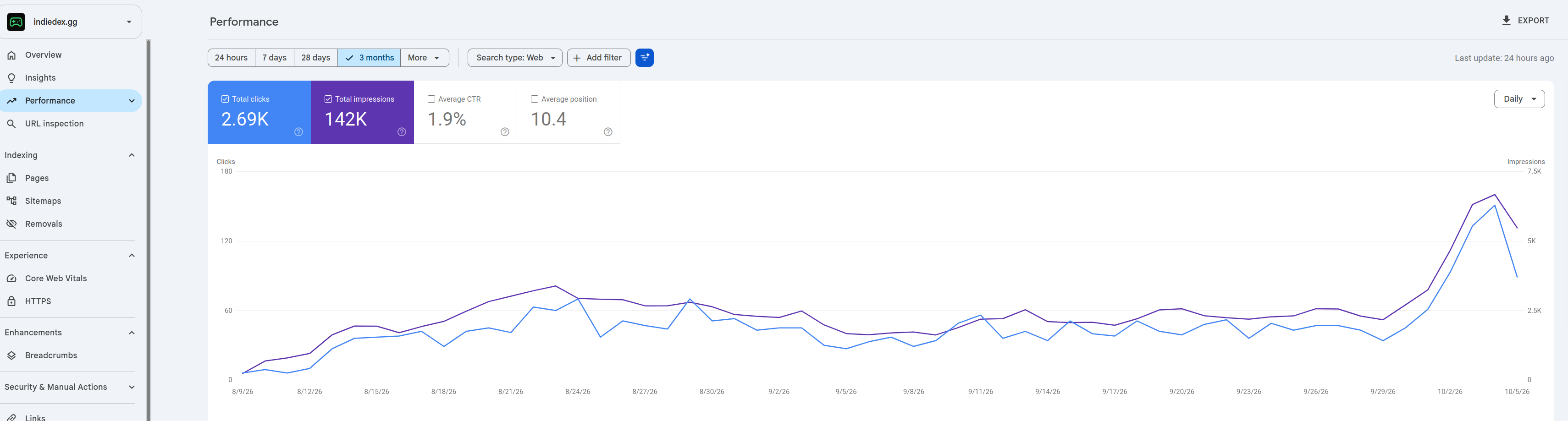
The catch with uncontested queries, as one r/bigseo member put it years ago:
“I’ve had sites organically in position 1 right from day one. The fact that the keywords being ranked for were - how shall I put this - infrequently typed in, however, means that page and position alone don’t really mean much.”
Edward Sturm shared a much faster story in his video:
“I once published a new page. I submitted it to Google Search Console right after it was published. Within 5 minutes, this new page was ranking number one above the New York Times, which previously was ranking number one for my target keyword.”
He puts it down to the site’s authority, real users clicking from search, links getting shared, and having “more topical relevance to the keyword.”
I have never seen anything rank that fast against an authoritative site. I wonder how that happened for Edward.
The “uncontested” part is the key. Once there is real competition, Rand Fishkin’s read of the 2024 Google leak is blunt: “The content you create is unlikely to perform well in Google if competition from big, popular websites with well-known brands exists.” (SparkToro)
Why others barely move: engagement
New domains, competitive topics and, honestly, bad content. I think that is the mix. If you have a new domain and make no effort to promote what it is about, Google has no user data on it, and I think that makes it hard. I believe there was a leaked document from Google that mentions this too, and I felt validated when I read it, because it was always something I felt was working behind the curtains.
I think this is possibly the greatest SEO signal of them all: engagement. People focus so much on building backlinks and authority, but if your content sucks, your engagement will suck. And no matter how many backlinks you have, Google will eventually lose faith in your site if you are not engaging or helpful.
The 2024 leak exposed internal Google API documentation with attributes like “goodClicks”, “badClicks” and “lastLongestClicks”. As Fishkin read it, Google seems to measure how long people stay on a page after clicking from search, and pogo-sticking, when a searcher clicks a result and quickly hits back.
This isn’t only leak-reading. In the US antitrust case against Google, Judge Mehta’s 2024 ruling describes Navboost as a signal “that pairs queries and documents through memorizing user click data”, trained on 13 months of user data, and quotes an internal Google document calling it “one of the most power [sic] ranking components historically”.
Google confirmed the leaked documents were real, but warned “against making inaccurate assumptions about Search based on out-of-context, outdated, or incomplete information.” (Wikipedia, citing Google’s statement to The Verge)
The “lose faith” part isn’t just a feeling either. In September 2026, a site owner asked Google’s John Mueller on Bluesky why their pages sat at “Crawled - currently not indexed” for months, even with “lots of organic backlinks (Hackernews/Product Hunt various blogs writing about us)”. Mueller’s answer:
“Programmatic SEO like this often leads to a site that’s either spam, borderline spam, or low quality. It’s easy to spin something up with many pages, it’s hard to provide real value to users. Our systems have possibly lost faith in your site providing good value to users based on the old pages.”
And on timing: “Resolving this tends to take time & significant effort to show the value.” (Bluesky)
Links and promotion speed up the clock
Sturm’s advice for speeding things up is to get shared, get backlinks and get clicks from Google for non-branded terms:
“The slowest is when you don’t have much authority, when you don’t have much shares, when you don’t have a lot of backlinks or traffic.”
Google’s own crawl docs back up the crawling half of that: “URLs that are more popular on the Internet tend to be crawled more often to keep them fresher in our systems.” (Google Search Central)
And of course backlinks. I have had a site that was very generic in content, but I added some good backlinks to it, shared the posts on communities and drove traffic to the site. That always seems to give Google engagement signals to get it ranking.
But I also notice a lot of these sites eventually die off. I think it is partly because the way I do the promotions is very precise, so the traffic and audience going to the site are very relevant. Once I hit the SERP, it may be a different story: maybe I am ranking for the wrong intents, and there’s a mismatch between the value delivered and what the audience wants in the organic channel, versus what I observed in the more intentional and targeted outreach.
A fast start doesn’t guarantee you keep the spot, either:
“Once established, I’ve had new content pages ranking in the top 5ish results hours after posting them, but they generally slump down after the freshness wears off to about page 2.”
The site that ranked for 4 years, then died
It was a site in the social skills niche. I shared it on some Reddit communities about social skills, confidence, etc… The site ranked well for about 4 years, but I could see engagement was bad: the average time per session was less than 10 seconds, and the bounce rate was really high, above 85%. At its peak, this site was bringing between 300 and 500 clicks per day, and it had 30 articles. I think there was an update sometime in 2024 that really killed it.
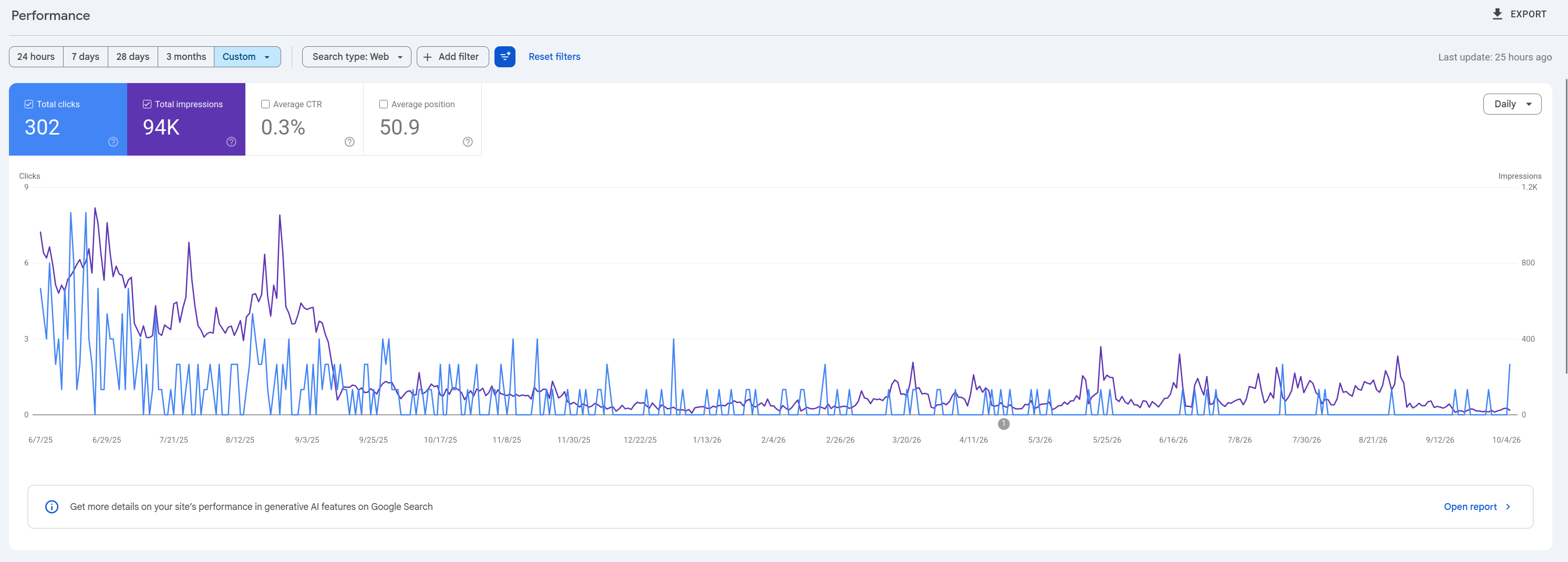
I am currently running an experiment to revive this site, which started on October 3rd, so let’s see if I can revive it. I redid the whole content and design/UX to make the pages more valuable and engaging, and promoted it on Reddit again. It already shows much better signs of engagement, with the average session around 30 seconds and some people visiting multiple pages.
If the revival works, Google’s docs say not to expect it overnight: “some changes can take effect in a few days, but it could take several months for our systems to learn and confirm that the site as a whole is now producing helpful, reliable, people-first content in the long term. If it’s been a few months and you still haven’t seen any effect, that could mean waiting until the next core update.” (Google Search Central) That lines up with the 3-6 month core update recovery in Illyes’ table.
How I run a new site now
Honestly, I would answer with “it depends on the site”. I always prepare myself for the worst case scenario. I think getting some backlinks and promoting the content does accelerate the clock, but your focus needs to be on the long term: the content quality and engagement.
The way I do things: I launch a site, leave it alone for a week or two, and promote it occasionally. Then I try to get some foundational backlinks (which I’ll write about later, and share a resource of free ones that anyone can get), and one or two good backlinks via niche edits or guest posts. After that, I stop building backlinks. At that point, my site and content need to be capable of standing on their own and attracting organic backlinks as they rank higher. If it can’t do that, then I did something wrong on the content and I need to rethink.
This process does take months. It is a slow process of monitoring and coming up with hypotheses, not a “this week I had 10% less impressions, let me fix it real quick” type of thing, which I see a lot of people trying to do.
I’m not the only one who plans this way:
“When I built websites focused on content, I usually make a 1 year plan, and I have little or no expectations over that one year. … In most cases there is a turning point where all of a sudden most of the keywords rank properly.”
So, do my experiences match the experts?
Mostly, yes. Google says a new URL typically gets discovered in about 20 hours, and I usually see the first impressions after 2 or 3 days, with signs of life by week two or three. Ahrefs found that about 40% of the pages that make it to the top 10 do it in their first month, which is what IndieDex did with pages nobody else was targeting.
Where I disagree is speed against big sites. Edward Sturm ranked above the New York Times in 5 minutes. I have never seen anything rank that fast against an authoritative site.
And the experts back up the thing I care about most: engagement. Navboost runs on click data, the leak talks about good and bad clicks, and Mueller says Google can lose faith in a site that isn’t providing value. My social skills site ranked for about 4 years with bad engagement, and I think an update in 2024 is what killed it. Backlinks and promotion can start the clock, but the content has to keep it running.
So when someone asks me how long SEO takes, I still say it depends on the site. I plan for the worst case, and I give it months, not days.
And let’s be honest, not knowing how long things take, what to do next, why to do or not do something, and “why did my site die” is the SEO experience.